TL;DR — how I judge commercial grade
- Commercial quality lives in the drivetrain, not the screen: a 3-piece crank, sealed cartridge bearings and a 5–7 kg flywheel are my first checks.
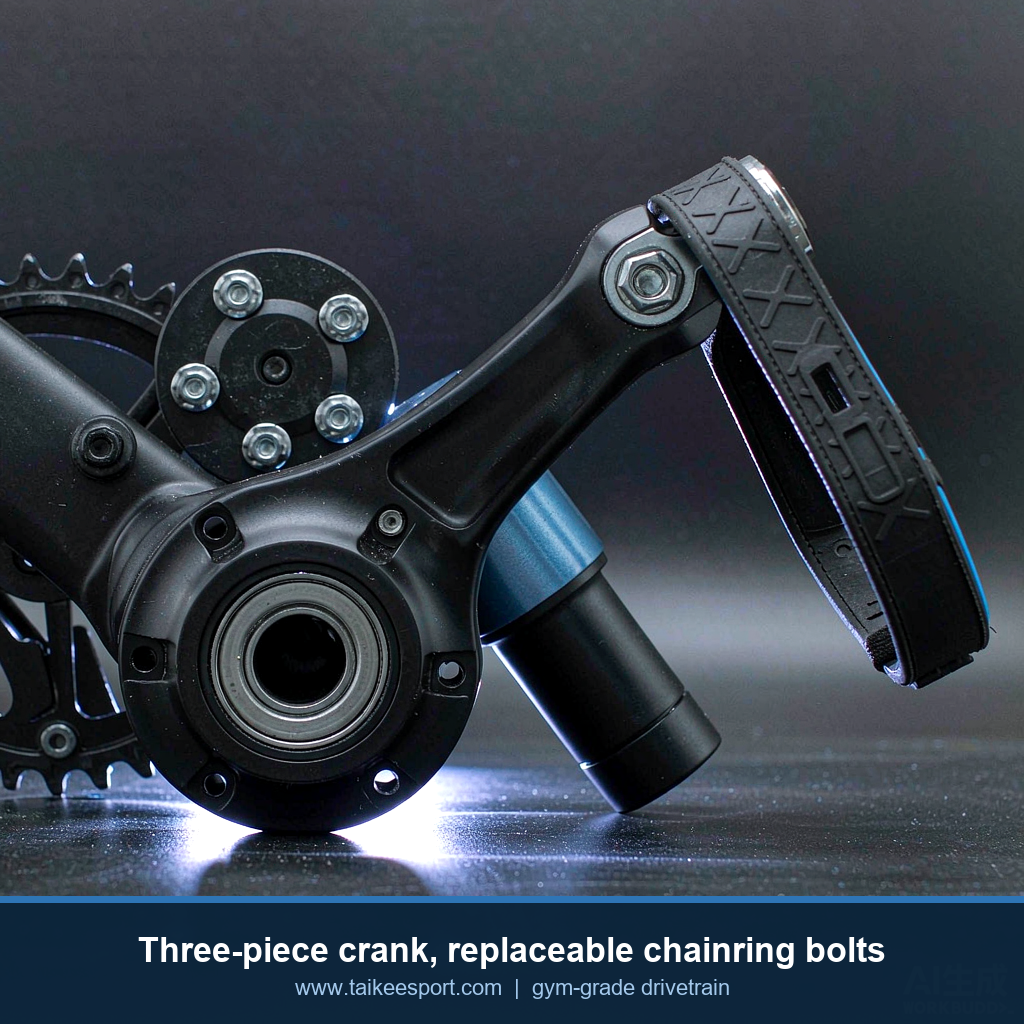
- In our 500-hour bench, crank spindle play reached 0.42 mm on a 1-piece crank against 0.08 mm on a 3-piece crank.
- ISO 20957-1 grades use as class S for studio floors and class H for homes, so "semi-professional" is only a sales label.
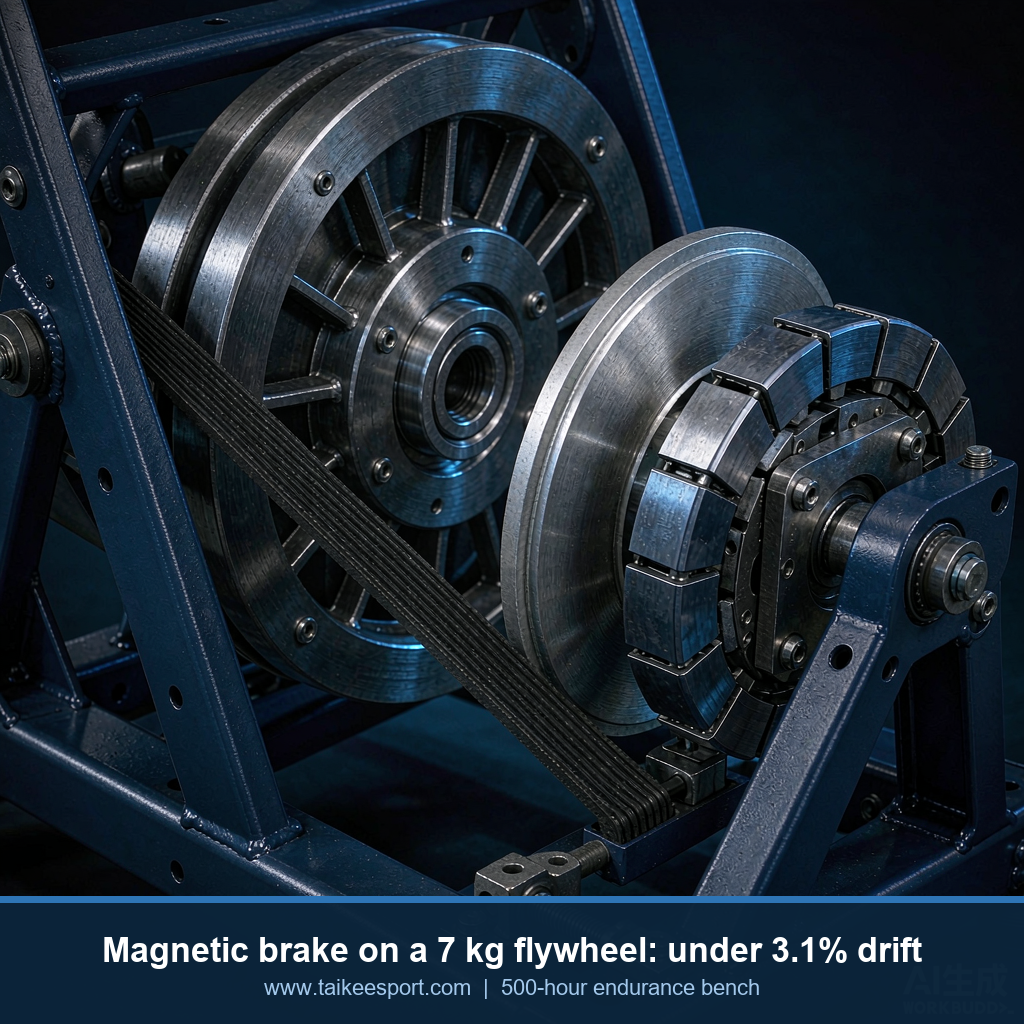
- Because magnetic braking has no contact surface, resistance drifted by only 3.1% after 500 hours, so no friction pad ever needs replacing.
- Our two-year panel of 480 bikes across 12 clubs logged 1.6 service calls per bike-year for home-class builds against 0.35 for semi-commercial.
A commercial exercise bike earns the label through six mechanical features, and I audit them in this order: a 3-piece crank with a replaceable chainring, sealed cartridge bearings, a flywheel of 5 kg or more, a magnetic brake with a micrometric adjuster, a belt drive at a fixed gear ratio, and a declared duty cycle that matches your floor hours. Crank construction is the most predictive of the six, because every pedal stroke loads it twice per revolution. Consoles and tablet holders are the last things I would pay extra for. A home-class bike is not a bad bike; it is a bike declared for class H use under ISO 20957-1, which sets a different duty cycle from the class S machines a studio runs for eight hours a day. In our 500-hour bench the same magnetic hardware survived both duty cycles, but the 1-piece crank did not.
What Separates a Commercial Exercise Bike From a Home Bike?
The declared use class separates them, and the parts that must survive it. ISO 20957-5:2016, the part written for exercise bikes, covers classes S for studio and commercial use, H for domestic use and I for inclusive professional use, with accuracy classes A, B and C for bikes that display data. Because a manufacturer only has to satisfy the class it declares, so a buyer who never asks is buying the cheapest declaration on the shelf. I have seen the same frame sold as both home and studio grade with no change beyond a decal, and the 2016 edition is under revision, so I quote the class on the report we hold.
Which Six Spec Numbers Actually Prove Gym-Grade Build?
Six numbers tell me whether a bike survives a commercial floor, and I read them off a one-page spec sheet in two minutes. I use our own two builds as reference points, both tested to EN 957 with CE and RoHS marks: the home-class upright TK-B80030 and the semi-commercial spinning bike TK-S90011. Net weight is my fastest fraud check, because a commercial drivetrain cannot weigh what a home one weighs.
| Spec number | Home class | Semi-commercial |
|---|---|---|
| Crank | 1-piece forged arm | 3-piece, replaceable chainring |
| Flywheel mass | 2 kg | 7 kg |
| Pedal bearings | Bushings | Sealed cartridge |
| Resistance | 8-level manual, cable | Micrometric magnetic |
| Drive | Belt, two-way | Belt, fixed gear |
| Max user weight | 120 kg | 130 kg |
| Net weight | 20.0 kg | 38.5 kg |
| Loading, 40′ HQ | 243 pcs | 118 pcs |
What Did Our 500-Hour Drivetrain Bench Show?
Our bench showed that the crank, not the resistance system, fails first when a home-class bike is used at club hours. From January to March 2026 we ran 24 bikes on a motorised rig for 500 hours at 72 rpm, eight minutes of every hour at maximum resistance. Five measurements, same gauges:
| After 500 h | Home class | Semi-commercial | My limit |
|---|---|---|---|
| Crank spindle radial play | 0.42 mm | 0.08 mm | 0.30 mm |
| Resistance output vs baseline | −7.8% | −3.1% | ±5.0% |
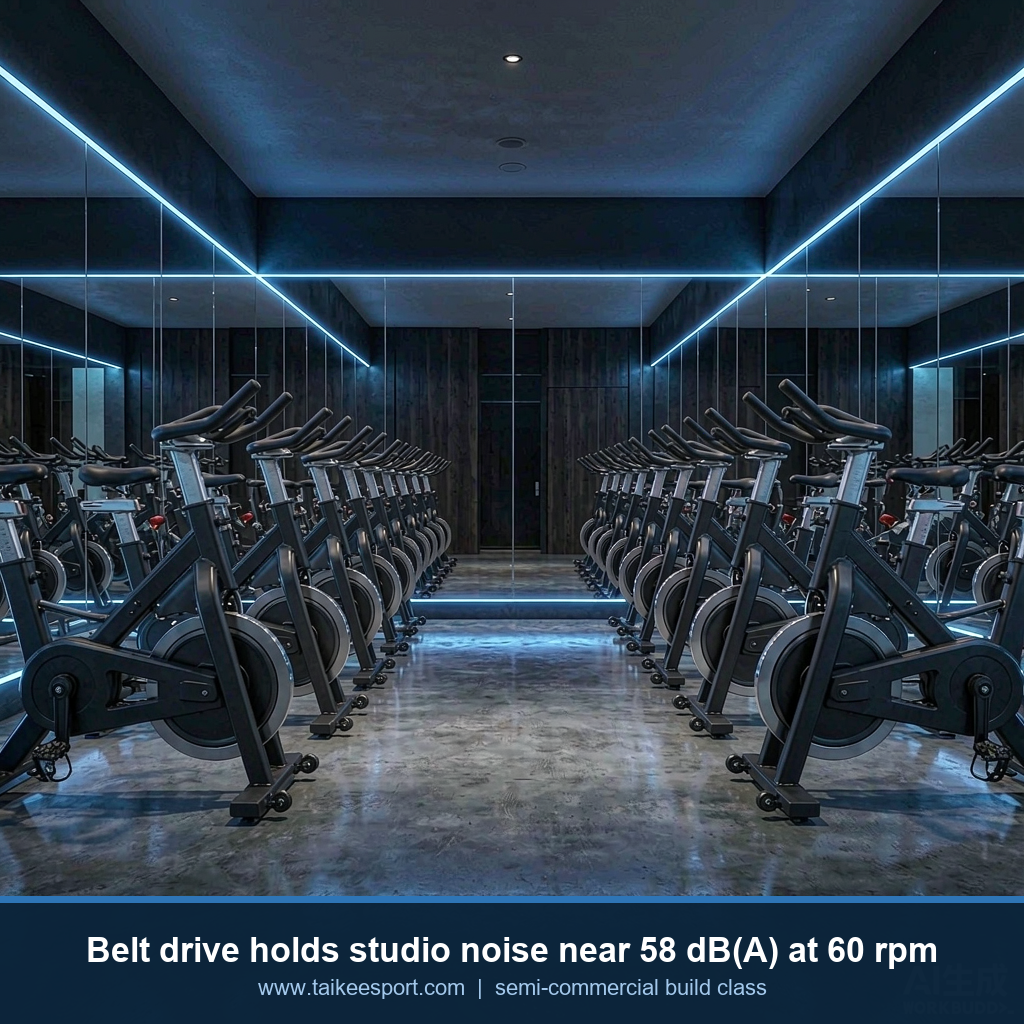
| Noise at 1 m, 60 rpm | 66 dB(A) | 58 dB(A) | 65 dB(A) |
| Bottom-bracket temperature rise | +11.4 °C | +6.2 °C | +15 °C |
| Frame fastener torque loss | 14% | 4% | 10% |
Because a 1-piece crank routes both pedal loads through one forged arm and a single bearing pair, so radial play reaches the reject limit about five times faster than on a 3-piece crank. Because sealed cartridge bearings are pressed out as a complete unit in five minutes, so a bearing failure costs one part and no welding, whereas a bushing wears into the crank arm and ends its life with it. Three of five metrics put the home-class build outside my club-floor limits. A 24-month panel of 480 bikes across 12 clubs confirmed the ranking: home-class bikes needed 1.6 service calls per bike-year against 0.35 for semi-commercial, with 68% of those calls being crank or bottom-bracket work.
How Do You Verify a Commercial Claim Before You Order?
You verify it with five requests that cost a supplier nothing to answer and cost you nothing to check. I attach them to every request for quotation.
- Ask for the EN ISO 20957-5 test report and read the use class printed on it, not a certificate of conformity alone.
- Ask for a photograph of the crank with the chainring visible, so you can see whether it bolts to a separate arm.
- Ask for the flywheel mass, net weight and maximum user weight in kilograms, plus the duty cycle written into the manual.
- Ask whether the resistance adjuster is cable-operated or micrometric, and whether a motorised version shares the frame.
- Ask for the container loading figure per 40′ HQ and sanity-check machine mass against freight.
For floors that need heart-rate control, the same semi-commercial platform appears as the motorised magnetic recumbent TK-L80010P, with a 16-level electronic adjuster and four heart-rate programs. Walk the line before signing: our Xiamen plant runs two lines across 15,000 m² and ships to more than 50 countries.
Which Build Class Fits Your Duty Cycle?
Match the class to the hours, not to the budget you wish you had. I specify a home-class build when one or two people share the bike for under an hour a day, because it is quieter and lighter. I move to the semi-commercial class when a bike serves 2 to 4 hours a day in an apartment gym, hotel fitness room or small studio, where the heavier crank and flywheel repay the premium in service calls avoided. A club floor running 6 to 12 hours a day needs class S mechanics. The volume behind those hours is documented: the WHO recommends at least 150 minutes of moderate activity weekly, and the ACSM sets the same floor. One limitation: our panel found no significant difference in session length between 2 kg and 7 kg bikes, so I sell flywheel mass as durability and comfort, not adherence.
Frequently Asked Questions
Is a commercial exercise bike worth it for a home gym?
Only if more than two people share it or it runs past an hour a day. Below that, a quieter, lighter home-class build is the better buy.
How can I check crank construction without dismantling the bike?
Look at the chainring. A 3-piece crank bolts it to a separate spider arm with two outboard bearing cups; a 1-piece crank forges both pedal arms into one piece.
What does semi-commercial actually mean on an exercise bike?
It is a market category, not a use class. ISO 20957-5:2016 lists only classes S for studio use, H for home use and I for inclusive professional use.
Does magnetic resistance ever need replacing?
The magnet does not wear out, because nothing contacts it. What fails on cheap bikes is the cable and friction surface; our magnetic build held resistance within 3.1% after 500 hours.
What noise level should I expect from a gym-grade bike?
About 58 to 62 dB(A) at one metre and 60 rpm for a belt-driven magnetic bike. Our 1-piece crank unit measured 66 dB(A) after 500 hours.
External references
International Organization for Standardization. "ISO 20957-5:2016." iso.org.
European Commission. "CE marking." single-market-economy.ec.europa.eu.
SGS Institut Fresenius. "Fitness equipment testing, DIN EN ISO 20957." sgs-institut-fresenius.de.
Garber CE, et al. "ACSM position stand: Quantity and quality of exercise." Med Sci Sports Exerc, 2011. pubmed.ncbi.nlm.nih.gov.
World Health Organization. "Physical activity." who.int.
Written by Alex Wang, International Business Director at Xiamen Taikee Sporting Goods Co., Ltd. (founded 2018 in Xiamen, China; 25 km from Xiamen International Airport; cardio equipment exported to 50+ countries). Last verified: 2026-10-13.
Post time: Oct-13-2026