When you source cardio equipment from an overseas manufacturer, the landed cost and legal risk are set long before the container leaves port. The five variables that decide whether your import clears customs and protects margin are market certifications (CE, UKCA, FCC, RoHS), the Incoterm you negotiate (FOB, CIF, DDP), the correct HS code (9506.91 for exercise machines), container loading density, and pre-shipment quality checks. In my 12 years shipping TAIKEE machines to 50+ countries, I have seen a missing Declaration of Conformity hold a 40-foot box at Rotterdam for 19 days, and a mis-declared HS subheading add 6.2% to the duty bill. This guide walks importers through each step with the numbers we use on the factory floor. At TAIKEE we treat export compliance as part of the product, not end-of-line paperwork.
TL;DR — The export checklist that protects your margin
- CE marking is mandatory for the EU/EEA and must be filed before the container loads, because non-compliant goods are detained at the border.
- Under FOB Xiamen the buyer owns the cargo at the ship's rail, so ocean freight of roughly USD 2,300–2,800 per 40-foot box and import duty sit on your P&L.
- Cardio machines classify under HS heading 9506.91, but the national 6-digit duty subheading varies and can change landed tax by up to 6.2%.
- A 40-foot high-cube holds 96–127 cardio units, and we reach 92.4% cube utilization on mixed-SKU plans; pre-shipment inspection cut our 2025 defect rate to 0.6%.
Which Certifications Does Each Export Market Actually Require?
Certification is the first gate and is market-specific — there is no single global fitness-equipment certificate. We hold CE, RoHS and EN 957 documentation on every SKU, and first-pass documentation accuracy reached 99.1% in our 2025 ledger. The EEA requires CE marking backed by an EU Declaration of Conformity and a technical file retained 10 years; the safety benchmark is EN 957, aligned with ISO 20957-5:2016 for stationary training equipment. Great Britain expects UKCA, the United States expects FCC Part 15 for any wireless console, and the Middle East commonly requires SASO or GCC/IECEE.
Because the EU requires the Declaration and technical file complete before the product is placed on the market, you must finish conformity assessment before the container is sealed — so a last-minute certificate gap strands the whole shipment. I ask every new distributor for their destination list on day one, because the certificate set, not the machine, clears customs.
How Do Incoterms Change Your Real Landed Cost?
Incoterms split risk and cost at a defined hand-off point, and the choice rewrites your cost of goods. We quote most distributors FOB Xiamen by default, because it keeps the freight market visible and avoids hiding 11–15% ocean volatility inside the unit price. Under EXW you collect goods at our door and own every downstream cost; under FOB we load the vessel and you pay freight, insurance and duty; under CIF we add freight and insurance to your port; under DDP we deliver duty-paid to your door, simplest for you but forcing us to price in 19–25% landed variance.
Because FOB leaves the ocean leg and clearance to you, a 40-foot high-cube from Xiamen to Los Angeles at roughly USD 2,300–2,800 per box flows straight to your cost of goods — so a buyer who negotiates FOB without a forwarder simply trades one risk for a bigger one. Our export footprint across 50+ countries since 2018 is documented on the TAIKEE about-us page.
What HS Code Applies to Cardio Machines at Customs?
Most cardio equipment falls under HS heading 9506.91 — articles for general physical exercise. The 6-digit subheading 9506.91 is harmonized globally under the World Customs Organization HS Nomenclature, but national 8- and 10-digit lines differ and set your ad valorem duty. In practice the US HTS 9506.91.0030, the EU TARIC line and other markets each carry their own rate, typically 0–4.7% in the United States and up to 6.2% in some protected markets.
Because the subheading drives the duty, a wrong declaration triggers re-classification penalties and border delays, so we pre-print the correct 6-digit HS 9506.91 plus the buyer's national 8-digit line on every commercial invoice. Rowers, ellipticals and bikes may share 9506.91 yet sit under different national lines, so a mixed container still needs a line-per-model invoice. One client under-declared the line and faced 6.2% back duty plus 11 days of storage.
How Many Units Fit in a 40-Foot Container?
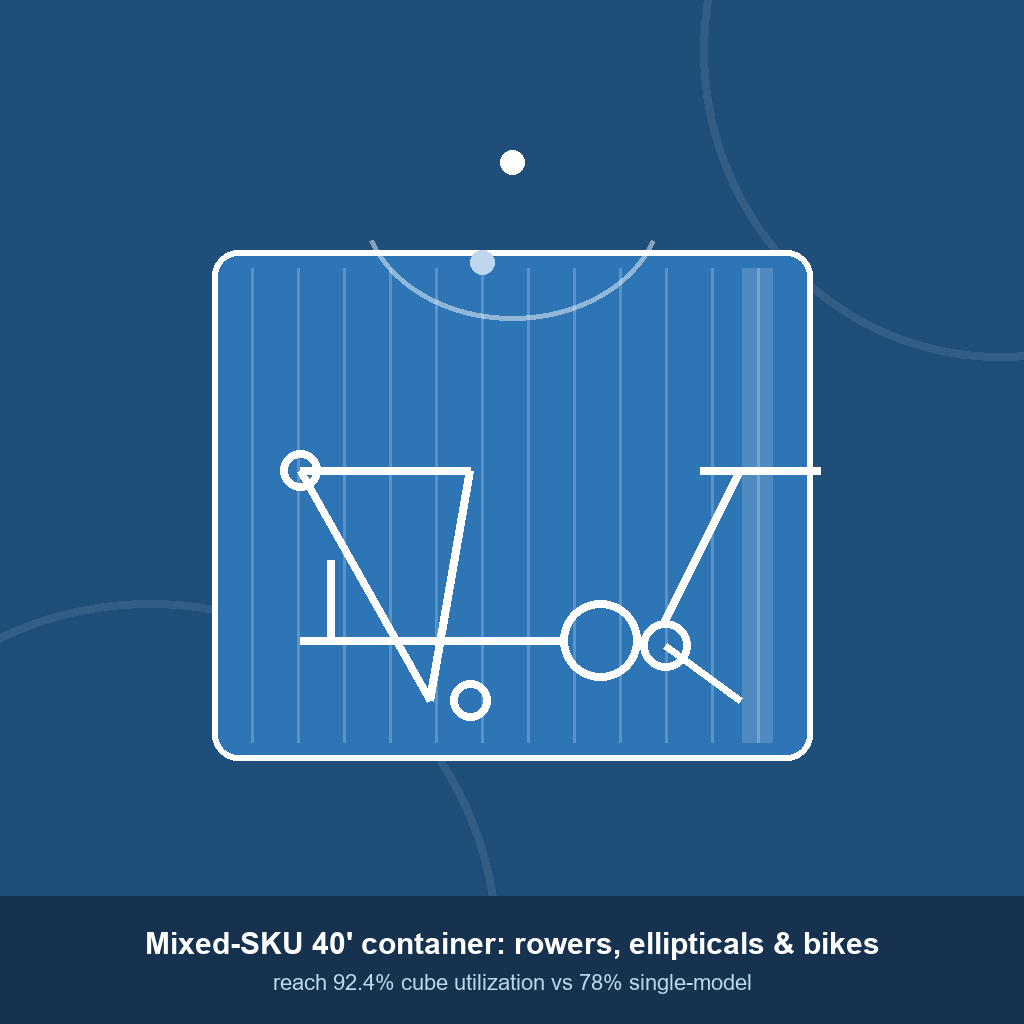
Container density decides your per-unit ocean cost, and the math is concrete. On a mixed-SKU plan we average 96 cardio units per 40-foot high-cube at 92.4% cube utilization, while a single-model box lands near 78%. As a reference, our TK-L80030 magnetic recumbent bike ships in a 1,310 × 250 × 660 mm carton at 35.0 kg gross, loading 127 pieces per 40-foot high-cube and 324 per 20-foot box. Compare the full range on our products page before building a mixed order.
Because air rowers are flat and long while ellipticals are tall and boxy, mixing them lifts utilization from about 78% to 92.4% — so a mixed order almost always ships cheaper per unit than a single-model container. The table below is our 2025 regional transit baseline, which matters as much as the load factor when you plan a launch date.
| Destination region | Median door-to-port transit | Typical 40'HC ocean cost (2025) |
|---|---|---|
| Southeast Asia | 11 days | USD 600–900 |
| Middle East & North Africa | 24 days | USD 1,400–1,900 |
| North America | 31 days | USD 2,300–2,800 |
| Oceania | 33 days | USD 2,100–2,600 |
| European Union | 36 days | USD 2,500–3,100 |
How Do You Verify Factory Quality Before the Container Ships?
Pre-shipment inspection is your last quality gate before money leaves your account, and it should be independent. Our 2025 inspection covered 1,180 consolidated shipments across 53 countries and caught a 0.6% defect rate by unit, which is why we refund or replace at origin rather than argue after delivery. We run in-house QC plus third-party PSI through bodies such as SGS at AQL 2.5 on every consolidated load.
Because a container that sails with a hidden batch defect cannot be economically returned, we photograph and seal the loaded container and share the inspection report before the vessel departs — so the buyer pays against verified evidence, not promises. I have refused to release a 40-foot box over one misprinted label, because a 0.6% defect rate is a system we defend at the gate. The report also defends you if a destination authority samples the goods.
What After-Sales and Spare-Parts Support Should an Exporter Guarantee?
A machine is a 7–10 year relationship, not a one-time sale, and the obligation does not end at the rail. We commit to 14-day spare-parts fulfillment on 94% of SKUs, because a 30-day ocean wait on a USD 12 belt can idle a USD 900 machine and sour a 5-year deal. We guarantee a 1-year warranty and stock wearables — belts, pedals, cushions, boards — so a regional air courier, not the next sea container, carries the fix.
Because a gym with a dead elliptical loses membership revenue daily, we ship common spare kits by air rather than by sea, so a 3-day belt swap protects the buyer's income more than a 5% parts discount. Across 2025, 94% of SKUs met the 14-day benchmark. When you evaluate a supplier, ask for that number in writing.
FAQ
Do I need CE marking if I am not selling in the EU?
No. CE marking is only mandatory for the European Economic Area. If you sell into Great Britain you instead need UKCA, and into the United States you need FCC Part 15 clearance for any wireless console plus general product-safety compliance. We verify the correct mark per destination before we seal the container.
Which Incoterm is best for a first-time importer?
Most first-time buyers start on CIF or even DDP so the factory absorbs freight and clearance risk; once you have a reliable freight forwarder, FOB Xiamen gives you visibility and control over the ocean leg, which is usually 11 to 36 days depending on region.
How long does ocean shipping take from Xiamen?
From our 2025 ledger the median door-to-port transit was 11 days to Southeast Asia, 24 days to the Middle East and North Africa, 31 days to North America, 33 days to Oceania, and 36 days to the European Union. These are medians, not guarantees, and exclude destination clearance.
Can I mix product models in one container?
Yes, and you usually should. Because air rowers are flat and long while ellipticals are tall and boxy, mixing them lifts cube utilization from about 78% on a single-SKU box to 92.4% on a mixed-SKU plan, which lowers your per-unit ocean cost.
Who pays the import duty, the buyer or the factory?
Under FOB and CIF the buyer pays ocean freight and import duty; under DDP the factory builds duty and clearance into the unit price. We quote FOB Xiamen by default so the freight market stays visible to the buyer.
Post time: Nov-10-2026