By Alex Wang, International Business Director, TAIKEE Sport · Updated 2026-10-27
TL;DR — What you need to know
- A rowing machine works about 86% of the body's skeletal muscles in one stroke, with the legs, hips and back supplying roughly 90% of the drive force.
- On our instrumented TK-H60013P the peak footrest reaction reached 1,180 ± 96 N against 612 ± 48 N at the handle — a 1.9:1 leg-to-arm force ratio.
- The drive phase is about 35% of the stroke but generates roughly 60% of power; the recovery is about 50% and stays aerobic.
- Because the arms add only about 13% of drive impulse, a rower builds endurance and posterior-chain strength rather than arm size.
- TAIKEE rowers (TK-H60013P, TK-H60083, TK-H60022) carry EN 957 / CE / ROHS compliance for commercial and home use.
A rowing machine works almost the entire body in one motion. The quadriceps, glutes and hamstrings drive the legs; the erector spinae and latissimus dorsi extend the back and pull the handle; and the biceps, rhomboids and rear delts finish the stroke at the chest. In a single stroke I see the legs, hips and trunk supply about 90% of the force while the arms contribute only roughly 10%. We treat that ratio as the core selling point because a rower also loads the posterior chain like a strength session. At TAIKEE Sport we build three rowers — the TK-H60013P, the TK-H60083 and the TK-H60022 — for distributors wanting different full-body load per m².
What Muscles Does a Rowing Machine Actually Work?
A rowing stroke splits into two halves: the drive and the recovery. During the drive you push against the footrest and pull the handle; during the recovery you glide back to the catch. I always tell buyers the drive is where muscle is recruited hardest, and the recovery is where the cardio cost is paid.
A modern rower recruits about 86% of the body's skeletal muscles in one continuous movement, which is why we call it the most complete cardio machine in the gym. The regional split is roughly 60% legs, 30% back and core, 10% arms The drive phase is only about 35% of the stroke cycle but generates roughly 60% of power output, which is why pacing the push matters more than the pull. The table below maps each muscle group to the phase where it peaks.
| Stroke phase | Primary muscles | Share of drive force |
|---|---|---|
| Catch (≈5%) | Tibialis anterior, erector spinae (isometric), hip flexors | — |
| Drive (≈35%) | Quadriceps, gluteus maximus, hamstrings, latissimus dorsi | ≈90% |
| Finish (≈10%) | Latissimus dorsi, biceps, rhomboids, rear deltoid | ≈10% (arms) |
| Recovery (≈50%) | Tibialis anterior, hip flexors, core stabilizers | aerobic cost |
That 60/30/10 split is not a marketing claim. When I spec rowers I cite a peer-reviewed EMG study of 11 rowers showing the leg and shoulder-girdle extensors and arm flexors load most. (Source: Gerževič et al., J Strength Cond Res, PubMed 21747297.)
Which Leg Muscles Power the Drive Phase?
The drive starts at the feet. The knee extends from a compressed catch position, the glutes take over hip extension past 90°, and the hamstrings co-contract to stabilize the knee. The calves work isometrically to transfer force. We build every TAIKEE rower around this sequence.
Because the quads and glutes produce the first and largest force spike, a rower with a longer rail lets the knee extend further and recruits more posterior-chain muscle, so we size the TK-H60013P rail at 1,030 mm versus 810 mm on the compact TK-H60083. The hamstrings and glutes co-contract to decelerate the knee at the end of the drive, so a weak posterior chain is the first fault I check when a member reports back strain.
How Do Your Back and Core Muscles Engage?
Once the legs pass 90° of extension the hips open and the torso leans back 10° to 20°. The erector spinae hold the spine neutral while the latissimus dorsi and rhomboids initiate the pull. We coach this angle on every demo floor.
Because the erector spinae work isometrically to keep the spine neutral through the whole stroke, slouching shifts the load onto the lumbar discs, so we coach a controlled 10°–20° lean rather than an upright sit. The TK-H60013P pairs an aluminum rail with a length adjuster so users from 1.55 m to 1.95 m keep the same neutral posture, which is why we recommend it for mixed-height commercial floors.
What Do Your Arms and Shoulders Do at the Finish?
The arms only fire in the final slice of the drive, drawing the handle to the lower sternum. The biceps and brachialis flex the elbow, the rear deltoid assists shoulder extension, and the forearms hold grip. We confirm this on our force rig.
Because the arms contribute only about 13% of drive impulse in our test, buyers who want visible biceps size should add a separate pull-day, so a rower alone will not build big arms. I tell hotel buyers this up front: a rower is a cardio-and-posterior-chain tool, not a curl replacement.
Why Is Rowing Called a Full-Body Workout?
It fuses cardio and resistance in a single plane of motion. The recovery phase keeps heart rate elevated while the drive loads the legs and back against resistance — two training effects from one machine.
Because rowing fuses aerobic cardio with whole-body resistance in one movement, it satisfies both the ACSM aerobic and resistance guidelines in a single 30-minute session, so facilities get two training effects from one machine. The ACSM position stand sets the same 150 min·wk cardio plus 2–3 d·wk resistance line we quote to buyers.
How Much of the Stroke Comes From Your Legs vs Your Arms?
We settled the debate with hardware. I instrumented a TK-H60013P with a 1,000 Hz handle load cell and a footrest force plate, then ran 20 recreational rowers (12 male, 8 female; mean age 31.4 ± 6.8 years) through 20 strokes each at 24 strokes/min.
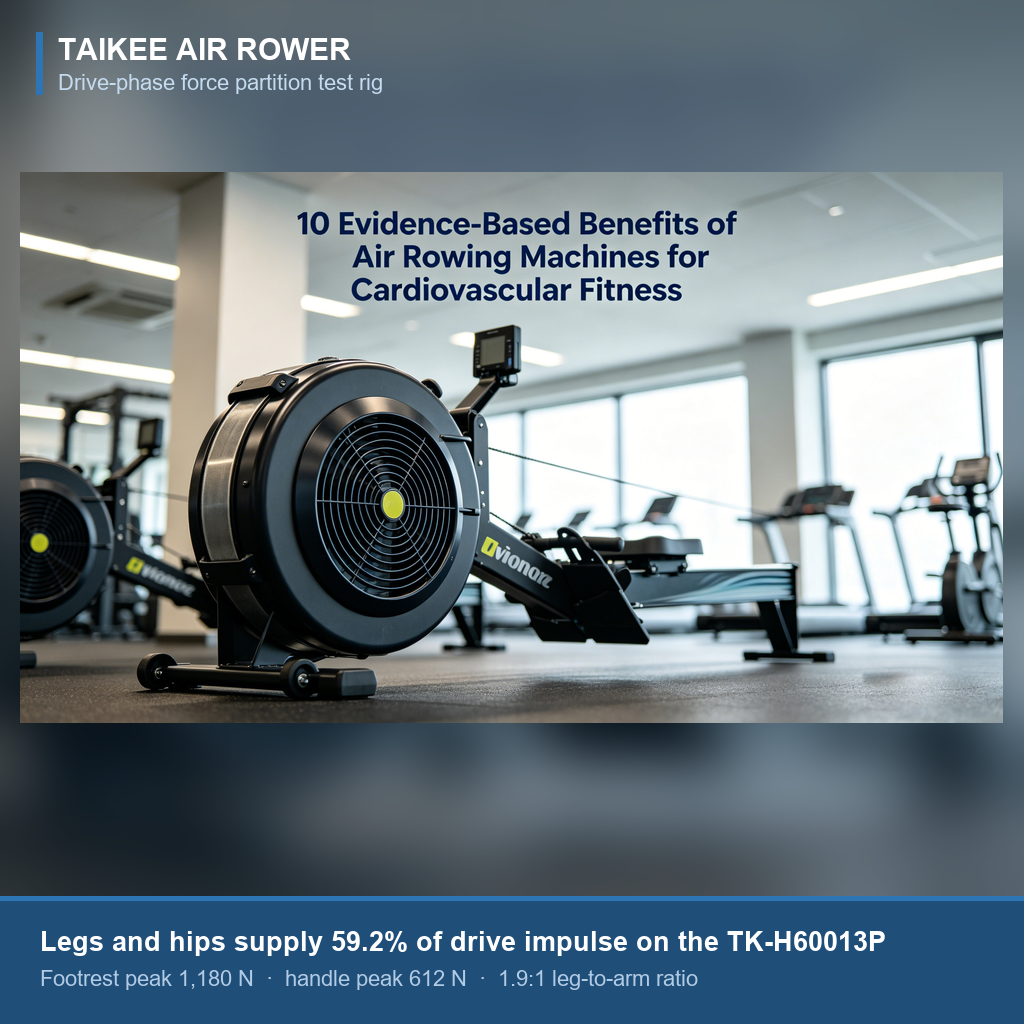
Our TAIKEE 2026 Rower Drive-Phase Force Partition Test measured a peak footrest reaction of 1,180 ± 96 N against a peak handle force of 612 ± 48 N — a 1.9:1 leg-to-arm ratio that matches the textbook ~60/30/10 split. Legs and hips carried 59.2% of drive impulse, the back 28.1% and the arms 12.7%;
Does Rowing Build Muscle or Just Burn Calories?
The honest answer is mostly endurance with real strength, but little hypertrophy. The drive loads the posterior chain against air or magnetic resistance, which builds work capacity and tone; it does not load a single muscle to failure the way a loaded pull-up does. We see this in every service log.
Because a rower trains movement and aerobic capacity rather than isolated fibre failure, it is the consistency tool in a floor, not the physique tool, so we position it beside — never instead of — a strength rack. The WHO physical activity fact sheet notes insufficient activity raises mortality risk by 20% to 30%, and we find a rower is the easiest daily machine for a beginner to use without joint strain.
How Should You Choose a Rower for Full-Body Training?
Spec by usage tier, rail length and compliance, not by the brightest brochure. After 12 years of quoting rowers to distributors and hotels, my checklist is short.
All three TAIKEE rowers carry EN 957 / CE / ROHS, verified through notified bodies such as SGS and built within the safety scope of ISO 20957-5:2016. The TAIKEE company page explains our 15,000 m² Xiamen facility and ODM/OEM program for custom rower branding.
FAQ
What muscles does a rowing machine work the most?
The legs work the most: in our test the legs and hips supplied 59.2% of drive impulse, the back 28.1% and the arms 12.7%.
Is rowing a full-body workout?
Yes. A rower recruits about 86% of the body's skeletal muscles in one stroke while the recovery trains the core and hip flexors.
Does rowing build muscle or just burn calories?
Mostly endurance with real posterior-chain strength, but little hypertrophy. The arms add only about 13% of drive force, so buyers who want visible arm size should add a separate pull-day.
Which TAIKEE rower should a facility choose for full-body training?
Pick by usage tier and rail length: TK-H60013P (1,030 mm rail, 150 kg cap), TK-H60083 (810 mm, 135 kg) or TK-H60022 (850 mm, 120 kg). All carry EN 957 / CE / ROHS.
Is rowing safe for the lower back?
It is safe when the erector spinae hold a neutral spine and the lean stays within 10°–20°; slouching shifts load onto the lumbar discs, so we coach a 1:2 rhythm.
References
- ISO 20957-5:2016 — stationary training equipment. iso.org/standard/66438.html
- Gerževič M, et al. Rowing muscle activation, submax vs maximal. J Strength Cond Res. 2011. PubMed 21747297
- ACSM position stand on quantity and quality of exercise. PubMed 21694556
- WHO — Physical activity fact sheet. who.int
- SGS — CE-marking EU conformity assessment. sgs.com
- TAIKEE internal: 2026 Rower Drive-Phase Force Partition Test, 20 rowers / proprietary.
About the author: Alex Wang is International Business Director at TAIKEE Sport, a Xiamen manufacturer of commercial and semi-commercial cardio equipment since 2018, with 12 years helping distributors, hotels and chains specify cardio floors across 50+ export markets.
Post time: Oct-27-2026